
MLOps8 min read
Person ReID domain shift: detection and response playbook
Detect Person ReID domain shift across cameras, venues, crops and populations, then reevaluate, recalibrate or adapt without hiding regressions.
A domain-shift incident can unfold over one weekend. On Friday, sentinel queries look normal. On Saturday, the same workflow moves to a venue with blue LED lighting, a higher camera position and tighter detector boxes. By Sunday, reviewers are rejecting confident-looking neighbours that would previously have been useful. The model revision has not changed. The world around it has.
That is a Person ReID domain-shift incident. Your first move should not be to loosen the threshold until candidates reappear. Freeze the current rule, identify what changed, and run a labeled evaluation on the new conditions. Only then can you decide whether the existing model still works, a recalibrated rule is enough, or adaptation is justified.
Here, “domain” means more than a camera brand. It includes capture geometry, lighting, image processing, crop generation, clothing, participant population, gallery composition and product behavior. Any one of these can move the embeddings or change which neighbours are relevant.
The practical Person ReID guide explains the wider retrieval system in which this shift must be measured.
Read the incident from the outside in
Put an old crop and a new crop side by side before inspecting the model. Is the body smaller? Has a portrait image been rotated? Does the new gallery contain ten times more black costumes? A change log with four groups keeps those observations separate.
Capture shift
- new camera sensors, lenses or compression;
- different camera height, distance and viewpoint;
- indoor versus outdoor light, stage illumination or color temperature;
- motion blur, lower shutter speed or changed resolution.
Subject and context shift
- different clothing conventions, uniforms or costume changes;
- a new event type, venue layout or participant population;
- more occlusion, crowding or interactions between people;
- seasonal changes that alter appearance and background.
Pipeline shift
- a new detector, tracking system or crop margin;
- orientation, color conversion, resize or padding changes;
- a new model or preprocessing revision;
- a different vector index or approximate-search configuration.
Product shift
- a larger or longer-lived gallery;
- a new rule for which cameras may match;
- a different threshold or top-k depth;
- less human review or a new automatic action.
The crop-quality checklist helps isolate pipeline changes before they are misdiagnosed as representation failure. The ReID embeddings and vector databases guide covers compatibility between model revisions and index settings.
Why camera changes matter
Person ReID research has repeatedly treated camera variation as a central challenge. The primary paper Camera Style Adaptation for Person Re-Identification studies visual style differences created by cameras and explores augmentation to reduce them. Later work on camera-aware domain adaptation explicitly models camera-level subdomains.
These papers demonstrate that the problem is technically real; they do not guarantee that a particular adaptation method will improve a private deployment. Target data, protocol, model and governance differ. Treat each method as a hypothesis to evaluate.
Establish a labeled sentinel set
Unlabeled monitoring can tell you that inputs changed. It cannot prove whether the returned people are correct. Maintain a small, governed sentinel set containing representative queries and gallery items for each important domain:
- every deployed camera or capture position;
- common and difficult lighting states;
- typical and crowded scenes;
- accepted crop-quality bands;
- hard visual negatives and allowed outfit variation;
- realistic gallery sizes.
Ground truth should be created by an appropriate process and separated from training. Store dataset version, provenance, use restrictions and the immutable model/preprocessing revision used in each run.
For example, a compact ballroom sentinel panel might include a back-facing dancer under warm light, a red costume partly hidden by a partner, two visually similar black outfits, and a loose crop that touches another couple. These four examples are not universal; they make recurring failure conditions visible before and after a change.
When a new venue or camera arrives, add a labeled target-domain evaluation before declaring it supported. The test does not need to copy an academic benchmark. It needs enough relevant, difficult examples to estimate the product’s ranking, false-candidate and review behavior with visible uncertainty.
Monitor leading indicators without confusing them for quality
Useful unlabeled indicators include:
- crop dimensions, aspect ratio and boundary contacts;
- blur, exposure and multi-person flags;
- embedding norm before and after normalization;
- score distributions for top-1 and top-k neighbours;
- no-result rate and candidates per query;
- camera-to-camera retrieval proportions;
- reviewer rejection and correction activity.
Compare these by camera, venue and pipeline revision. A sudden change can trigger investigation. However, a stable top-1 score histogram can coexist with more wrong neighbours, and a shifted histogram can reflect a harmless gallery change. Outcome labels are needed to measure relevance.
Use the Person ReID evaluation metrics on the sentinel set: Rank-k, mAP, threshold precision and recall, false candidates per query, plus reviewer workload. Report slices and counts rather than one blended average.
Use the vector field as an incident map
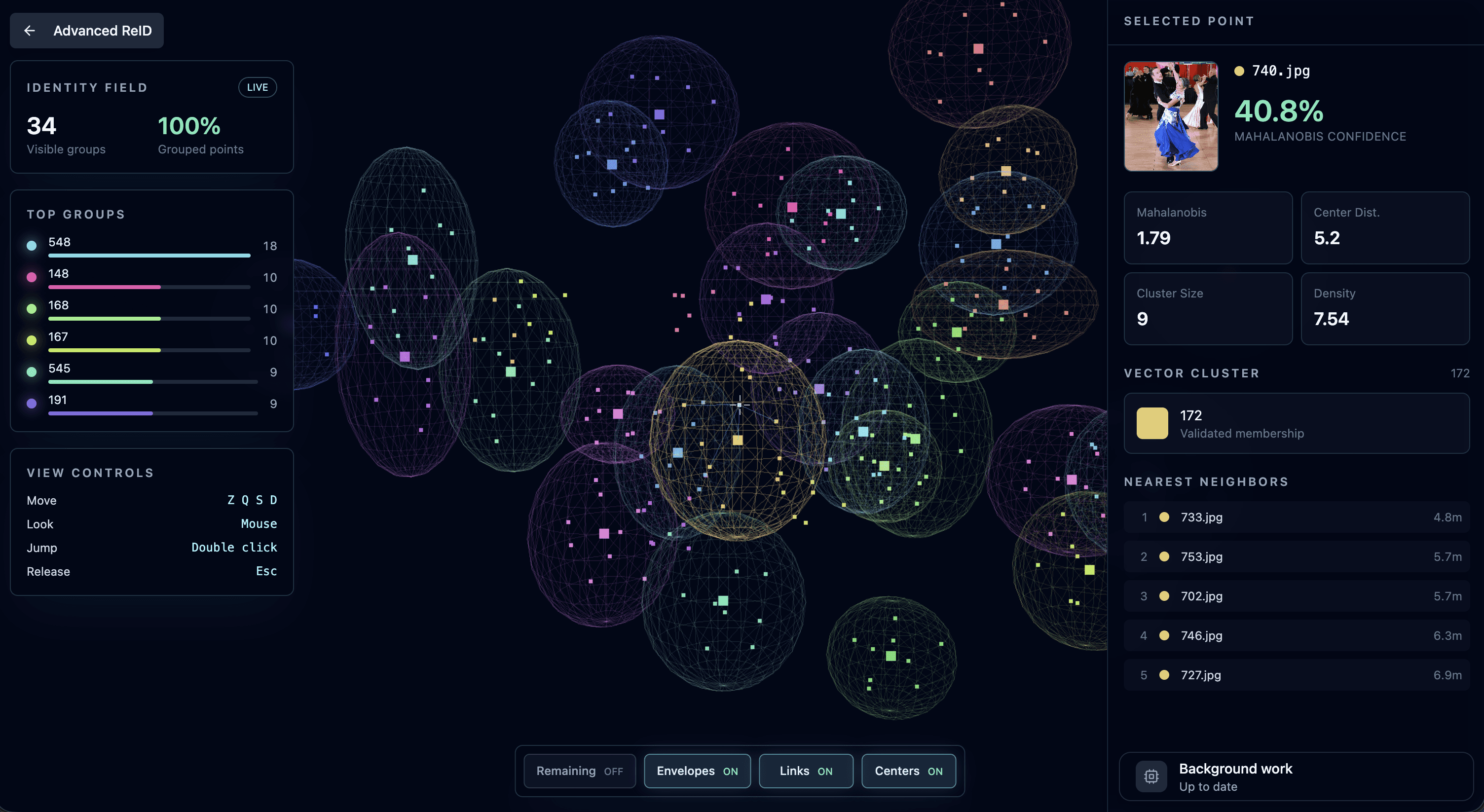
For a camera operator, the field gives a fast visual question: did the new camera produce points that still land around established groups, or did it create a separate island? A useful investigation follows the picture back to measurable inputs:
- filter or sample points from the changed camera, venue or cropper revision;
- inspect whether their neighbours belong to the same reviewed people;
- compare their crop quality, score distributions and labeled retrieval metrics with the previous domain;
- test the unchanged full-space system before changing thresholds or retraining.
The ellipsoids and the Mahalanobis value on the selected-point panel belong to the 3D projection. The distance divides each coordinate offset by the visible cluster’s variance, so a point that leaves a narrow part of the envelope stands out sooner than one moving along a naturally wide direction. This is useful for finding unusual points and camera-specific islands. It does not replace Rank-k, mAP or calibrated full-embedding thresholds on the sentinel set.
Follow a response ladder
1. Rule out an integration defect
Verify orientation, color decoding, crop coordinates, normalization, distance direction, model revision and index compatibility. Compare a known crop end to end. A broken resize or mixed vector revision should not trigger model retraining.
2. Characterize the new domain
Collect a governed sample and label it independently of model scores. Compare it with the existing sentinel set by capture condition, quality state and gallery composition. Record where the ranking changes.
3. Test the current model unchanged
Run the frozen model and the existing operating rule first. This establishes the regression rather than hiding it. If ranking remains useful but the score distribution moved, evaluate a new similarity threshold on a calibration subset and verify it on separate target-domain test data.
4. Adapt only with evidence
If representation quality is inadequate, options include adding labeled domains during training, supervised fine-tuning, domain-generalization training or carefully controlled unsupervised adaptation. The Self-Similarity Grouping paper illustrates an approach based on target-domain clustering and pseudo-labels. Pseudo-labels can also reinforce early mistakes, so inspect cluster quality and preserve an untouched test set.
When target data cannot be used for adaptation, multi-source domain generalization is another research direction. Memory-based Multi-Source Meta-Learning is one primary example. Again, the method must be reproduced and evaluated for the intended workflow.
5. Deploy as a new version
Do not overwrite old embeddings in place. Register a new model and preprocessing revision, rebuild a controlled gallery, compare old and new systems in shadow or limited rollout, and keep a rollback path. Recalibrate thresholds for the new vector space.
Do not adapt on ungoverned production feedback
Reviewer corrections can be valuable labels, but they are not automatically representative or correct. Operators may only inspect uncertain cases, creating selection bias. An interface may make some mistakes easier to notice than others. Before using feedback for training:
- define who can label and how disagreements are resolved;
- retain enough context to interpret the label;
- prevent a model’s own proposals from becoming unquestioned truth;
- separate training, calibration and test identities;
- apply purpose, access and retention controls.
The documented PolyReID API contract defines versioned embeddings; adaptation, gallery management and feedback governance remain separate system responsibilities.
Define reevaluation triggers in advance
Trigger at least an investigation after a model or preprocessing update, detector revision, camera change, venue expansion, material gallery-growth change or sustained shift in quality/review indicators. Trigger a labeled reevaluation when the intended population or automated action changes.
You cannot eliminate domain shift once and for all. You can make it visible through versioned inputs, sentinel data, explicit metrics and staged responses. The goal is not to force yesterday’s threshold onto tomorrow’s images. It is to notice when the evidence supporting your system no longer matches its environment.