
Research explained9 min read
Domain Generalization in Person ReID: BAU Explained
Understand Person ReID domain generalization and how the NeurIPS 2024 BAU method balances alignment, uniformity and augmentation reliability.
Your ReID model looks convincing in venue A. Then venue B opens its doors: different cameras, warmer light, tighter crops, unfamiliar clothing patterns. The model has not changed, but its visual world has.
Domain-generalizable Person ReID asks whether training on one or more source domains can survive that move to an unseen target—without updating the model on target images. The target identities are unseen too, so the system must transfer a useful appearance space rather than a fixed identity classifier.
BAU—Balancing Alignment and Uniformity—is one attempt to make that space transfer better. The method by Yoonki Cho, Jaeyoon Kim, Woo Jae Kim, Junsik Jung and Sung-Eui Yoon appeared in the NeurIPS 2024 main track. Its central puzzle is counter-intuitive: why can stronger image augmentation help on familiar data while hurting retrieval on an unseen domain?
The Person ReID guide explains how these embeddings become ranked candidates rather than identity declarations.
Put the embeddings on a globe
Picture every training image placed on the surface of a globe:
- Photos of the same training person should be near one another. This is alignment.
- The complete collection should still use the globe broadly instead of crowding into a few small areas. This is uniformity.
- An augmented photo should align with its original only when the transformation has not destroyed the useful evidence.
- Each source domain should avoid collapsing into its own visually biased corner.
BAU adds losses for these goals to a conventional ReID training pipeline. It does not create a new backbone. Its contribution is a representation-space regularization framework and a reliability-aware treatment of augmented views.
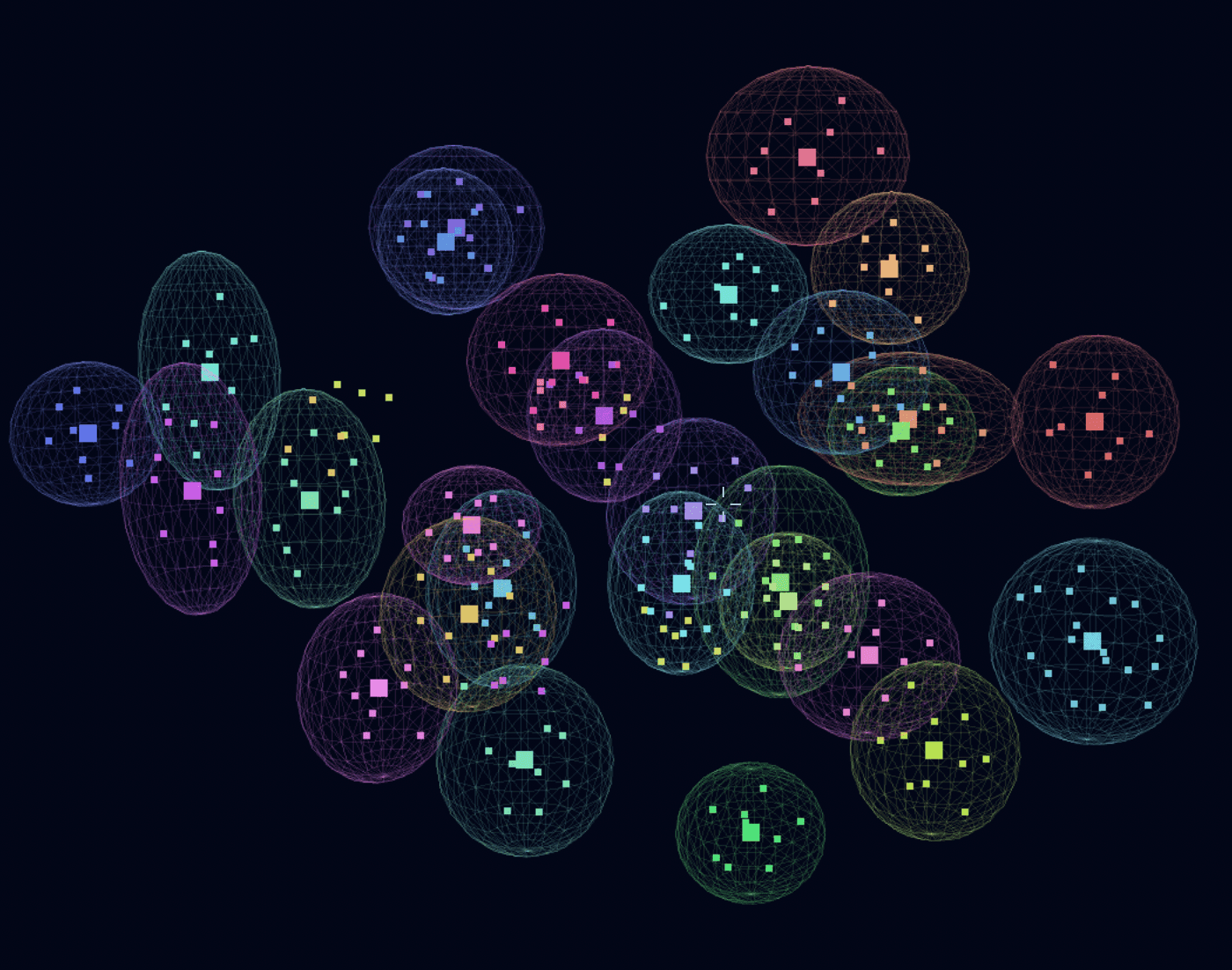
Read the visualization without mistaking it for the model
The illustration makes the geometry tangible, but it is not the space used directly for production retrieval. PolyReID produces a normalized 768-dimensional appearance embedding for each person crop. The explorer then uses t-SNE to project those vectors into three dimensions so an operator can move through them, inspect neighbours and see how reviewed groups occupy the field.
- A point represents one person crop.
- Nearby points preserve some local relationships from the full space, but their screen distance is only an exploratory projection.
- A colored envelope summarizes the spread of a visible reviewed group.
- The larger square marks that group’s center in the 3D view.
When a point is selected, the explorer also reports a diagonal Mahalanobis distance: sqrt(sum((coordinate - center)² / cluster variance)). A displacement along a tightly grouped axis therefore counts more than the same displacement along an axis where the group is naturally broad. The displayed “Mahalanobis confidence” applies exp(-0.5 × distance) × 100 to make that diagnostic easier to scan.
That number is not a probability that two images show the same person. It describes how typical the selected point looks relative to one cluster inside the 3D projection. Production retrieval still belongs in the compatible 768-D space, with thresholds evaluated on labeled data from the intended cameras, venues and populations.
First, keep the target outside the room
The distinction controls what evidence a result supplies.
| Setting | Target images available during training? | Target labels available? | Main question |
|---|---|---|---|
| In-domain training | Yes | Usually yes | Does the model work on held-out data from the represented domain? |
| Domain adaptation | Yes | Sometimes no | Can target data help adapt the model? |
| Domain generalization | No | No | Can source-only training transfer to an unseen target? |
| Production monitoring | Yes, after deployment | Sometimes | Does the deployed workflow still meet its measured requirements? |
This distinction is easy to blur in practice. If your “new” event influenced training or hyperparameter selection, it is no longer an unseen target. A random image split from the same event does not become a cross-event test just because the filenames differ. To claim source-only transfer, keep the target outside the room until the experiment is fixed.
When stronger augmentation makes the model narrower
Augmentation changes an image while preserving its training identity label. Color changes, erasing, cropping or geometric operations can encourage invariance to nuisance variation. But a strong transformation can also remove identity-relevant detail.
The BAU paper reports a “polarized effect” in its protocols: increasing augmentation can improve in-distribution retrieval while degrading out-of-distribution retrieval. Its analysis connects this behavior to an embedding space that becomes more aligned but less uniform. In simple terms, augmented examples may train the model to rely on a smaller set of dominant invariant cues, losing subtler information useful in a new domain.
This is an empirical finding under the paper’s models, augmentations and datasets. It does not mean augmentation always harms domain generalization. It motivates measuring both the retrieval outcome and the feature geometry rather than assuming that stronger transformations are automatically better.
Alignment pulls reliable views together
The alignment concept builds on Wang and Isola’s analysis of contrastive representation learning. BAU creates an augmented view of each source image and penalizes distance between original and augmented positive features.
Aggressive augmentation can produce an unreliable view. BAU therefore weights alignment using the Jaccard overlap of k-reciprocal nearest-neighbour sets for the original and augmented features. If their local neighbourhood structures agree, the pair receives more trust. If the neighbourhoods disagree, forcing invariance between the two views may be harmful, so the pair is downweighted.
“K-reciprocal” means that two samples consider each other neighbours under the chosen rule. The idea has a prior ReID lineage: k-reciprocal encoding was introduced for post-hoc retrieval re-ranking. BAU uses k-reciprocal neighbourhood overlap inside a training-time reliability weight. Those are related uses, not the same pipeline stage.
Uniformity spreads features across the hypersphere
Alignment alone can over-compress the representation. Uniformity encourages normalized embeddings to spread across the hypersphere. BAU computes a uniformity term over distinct feature pairs, counterbalancing the pull between original and augmented positives.
The intuition is not “push every image infinitely far apart.” The normalized sphere is bounded, and the objective balances multiple terms. Same-identity discrimination still comes from the complete training objective, which also includes conventional cross-entropy and triplet losses.
Uniformity is important for open-set ReID because test identities were not training classes. A representation that retains varied visual cues may organize unseen people more usefully than one dominated by a narrow shortcut. That is a hypothesis BAU evaluates under its stated domain-generalization protocols, not a universal geometric law for every deployment.
A memory bank looks beyond the current batch
A mini-batch only shows a small fraction of the training space. BAU maintains a memory bank of class prototypes, with one prototype per source training identity. Each prototype is updated with a momentum rule using features from that class.
BAU then applies a domain-specific uniformity loss between features and nearby different-class prototypes from the same source domain. The intended effect is to distribute each source domain more evenly and reduce domain-specific clustering.
This point is frequently misstated. K-reciprocal reliability weighting and a momentum-updated prototype memory bank are already present in the original NeurIPS 2024 BAU method. A later implementation can change their form, capacity or sampling policy, but it should not claim to have added those ideas to BAU for the first time.
The BAU mechanism at a glance
| Component | Purpose in the paper | Literature status | Important implementation choice |
|---|---|---|---|
| Cross-entropy and triplet losses | Baseline ReID discrimination on original images | Established ReID practice | Sampler, distance and loss weights |
| Original/augmented alignment | Preserve identity across transformations | BAU formulation builds on alignment theory | Augmentation set and probability |
| K-reciprocal reliability weight | Downweight corrupted augmented pairs | Included in original BAU | Neighbour count and batch composition |
| Global uniformity | Avoid an overly sparse feature distribution | Builds on Wang–Isola | Feature normalization and within-batch pair construction |
| Domain-specific uniformity | Reduce source-domain bias | BAU contribution | Source-domain definitions |
| Momentum prototype bank | Represent structure beyond the batch | Included in original BAU | Momentum and prototype initialization |
This breakdown makes reproduction easier: “using BAU” should identify which of these elements is implemented and which have been modified.
Where the internal report departs from BAU
An internal DINO-ReID report applies BAU-inspired regularization to a small event-photography identity pool. Instead of BAU’s label-indexed class prototypes, its equations show a fixed-capacity feature bank with per-slot momentum updates. They do not specify one slot per identity or BAU’s same-domain, different-class nearest-prototype selection. The report also uses its own bank size, momentum, neighbourhood parameters, augmentation views and training schedule.
Those are internal adaptations. They may be sensible when there are few identities or when the original class-prototype structure is inconvenient. They also change the algorithm. The implementation should be described as “BAU-inspired” or “an adaptation of BAU” unless it faithfully reproduces the published equations and memory structure.
Because the original NeurIPS method already includes a momentum-updated class-prototype bank, the internal version is best described as changing the bank structure and settings—not as introducing memory to BAU for the first time.
The same boundary applies to multi-view sampling. Choosing between raw crops, tighter crops and background-removed images at internally selected probabilities is an event-specific training pipeline. It is not an original BAU contribution.
Design the experiment before seeing the target
Before claiming domain generalization:
- Define each source domain and the held-out target before training.
- Keep target images out of training, model selection and threshold tuning.
- Separate target identities from all source identities.
- Compare with the same backbone, losses, augmentations and compute budget.
- Ablate alignment, uniformity, reliability weighting and domain-specific uniformity separately.
- Document the memory bank type, size, update rule and initialization.
- Report raw embedding retrieval separately from k-reciprocal re-ranking.
- Include Rank-k, mAP, uncertainty and domain-specific failure slices.
- Repeat across more than one held-out target domain.
- Test the intended production cameras, crops and gallery composition before deployment.
The operational response to a changing environment is covered in the Person ReID domain-shift playbook.
Where the evidence stops
BAU does not prove that all augmentations are harmful or that alignment and uniformity eliminate domain shift. It reports results for named benchmarks, source combinations, target datasets, backbones and hyperparameters. A new event type remains a new empirical question.
The paper also does not prove that a sample memory bank is equivalent to its class-prototype bank. That change belongs to the internal adaptation and requires its own ablation. Nor does BAU establish that a DINO backbone is superior to OSNet: such a conclusion would require the same data, objective, preprocessing, compute budget and evaluation protocol with only the backbone changed.
Cross-event generalization cannot be claimed when all reported events influenced training or tuning. Nor can a private metric be transferred to a served model without checkpoint, preprocessing, gallery and protocol traceability.